Profile
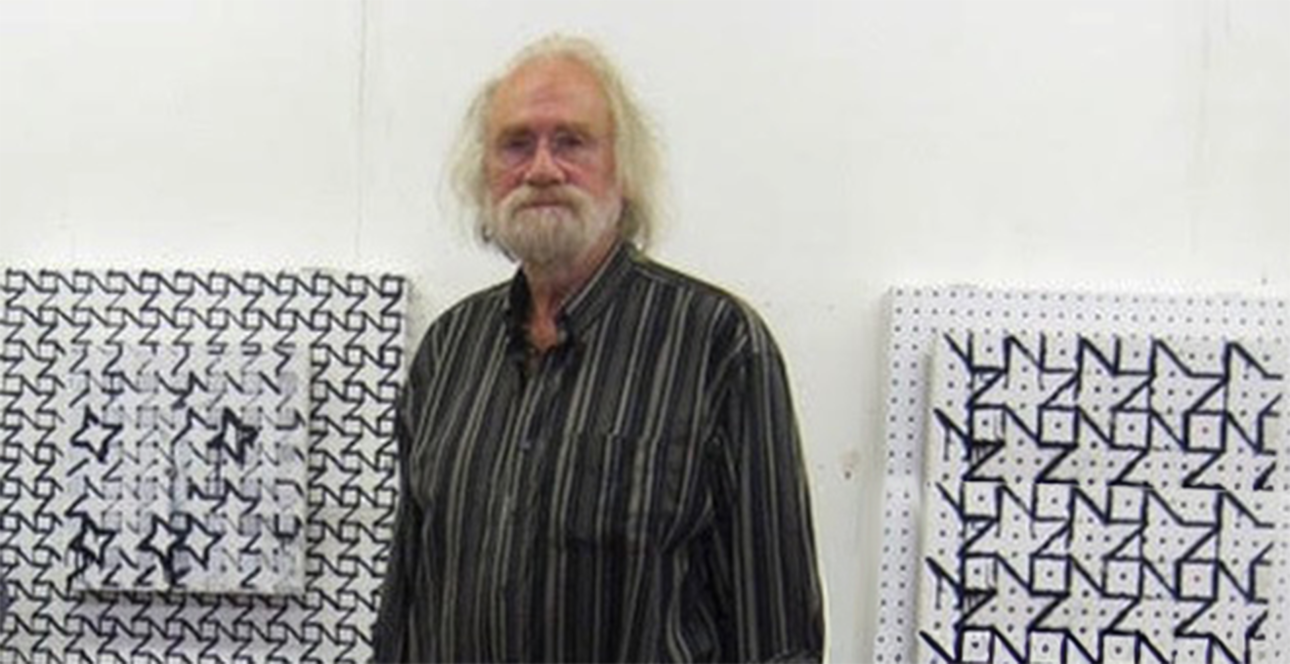
Born in London in 1939, and bombed out during the war, Norman Toynton was educated at the Hornsey College of Art and the Royal College of Art, where he won the painting prize in his first year. His work was shown at the Royal Academy when he was eighteen, and he was included in the first British Pop Art show at the Grabowski Gallery, with David Hockney and Allen Jones. He also participated in the first London happening, with Carolee Schneemann, at Dennison Hall. He won the Lignano Biennale Prize and the Prix Chateau de la Sarraz, was included in the John Moores Liverpool Exhibition, and showed at the Museum Schloss Morsbroich in Leverkusen, as well as at the Zwemmer Gallery (with John Walker), the RBA Galleries, and numerous other galleries in England, Scotland and Wales.
In 1969, Toynton moved to America, which he felt was more sympathetic to abstraction at that time, and lived there for thirty-seven years. Since the early seventies, he had been working on masonite pegboard, a moribund, Orwellian material that, as he wrote in a statement he was invited to contribute to the College Art Association Journal, “seems to stand for everything that threatens to destroy painting, the most individualistic, human activity I know of.” For precisely that reason, he set out to redeem it. Having begun his pegboard work with large installations, he gravitated towards doing smaller paintings, attaching lushly painted, vibrantly coloured square wooden structures to the pegboard with the hooks traditionally used with that material, and sometimes painting directly onto the pegboard itself.
His work was the subject of feature articles in ARTnews and Artforum, where Kenneth Baker, then the art critic for the San Francisco Chronicle, wrote, “Toynton is the only artist I know whose work resists intelligently the degrading social and commercial abuses of imagery without itself being representational”.
Toynton’s pegboard works were also favorably reviewed in Art in America, the Boston Globe, the New York Times, Studio International, Art New England, the London Times, the Observer, and the Boston Herald, among other publications. In the Boston Herald, Nancy Stapen wrote, “A superb handler of paint, Toynton endows these works with grand visual and tactile splendor….the explosive meeting of the monotonous pegboard with subtly variegated paint results in works rich in associational power.” In 1986, Arthur C. Danto chose another of Toynton’s solo exhibitions as one of his three Critics’ Year-End Choices in The Nation.
During his time in America, he had solo exhibitions at the Institute of Contemporary Art in Boston, the Williams College Museum, the Rose Art Museum at Brandeis University, the Stux Gallery in both Boston and New York, the Daniel Newburg Gallery, and the Stavaridis Gallery, as well as the Whitechapel Gallery in London. His work also appeared in numerous group shows in Boston and New York, including “American Drawing in Black and White” at the Brooklyn Museum and painting exhibitions at the Ruth Siegel Gallery, the John Good Gallery, and a dozen other New York venues.
Toynton was the chair of the Fine Arts Department at the University of Victoria in British Columbia and then head of the Graduate Program in Fine Art at the Massachusetts College of Art in Boston. He was also a visiting artist at the Tyler College of Art, the Royal College of Art, and the Rhode Island School of Design, among others, and was the recipient of grants from the Pollock-Krasner Foundation and the Adolph & Esther Gottlieb Foundation.
In 2006 he returned to England, settling in North Norfolk, though he also made several trips to India, where the brilliant colours he saw everywhere found their way into his paintings, and later began spending a month each autumn on the Greek island of Paros. During those years he had a solo show at the Dadiani Gallery on Cork Street, showed his work at the Yorkshire Sculpture Park and the Art Space Gallery, and for several years running was chosen for the Summer Exhibition at the Royal Academy.
He died in June 2025, at his home in Sidestrand, Norfolk.